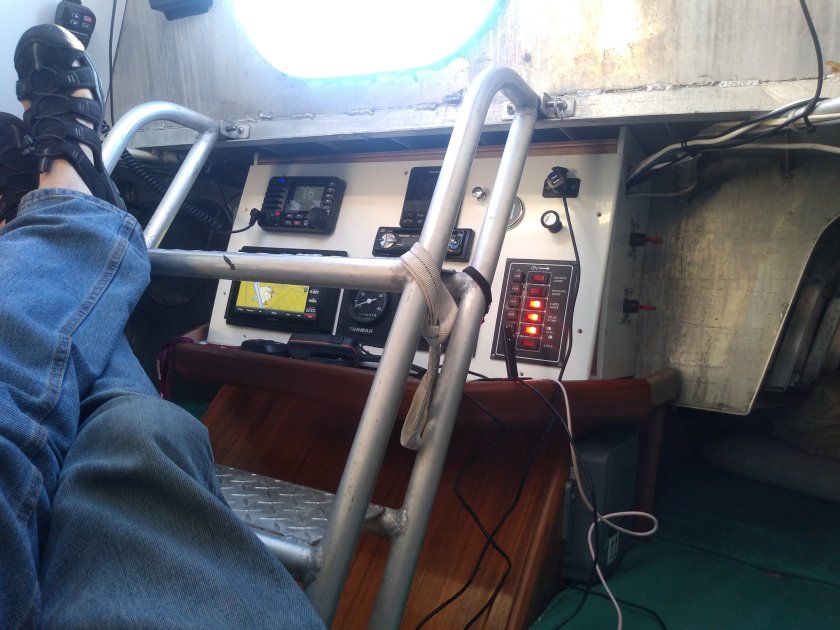
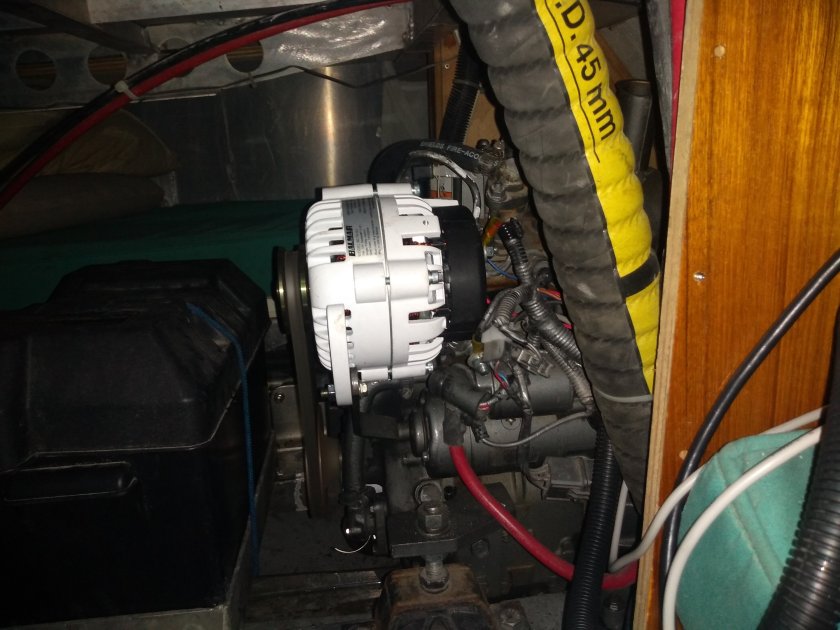
Getting to know Tin Lizzie

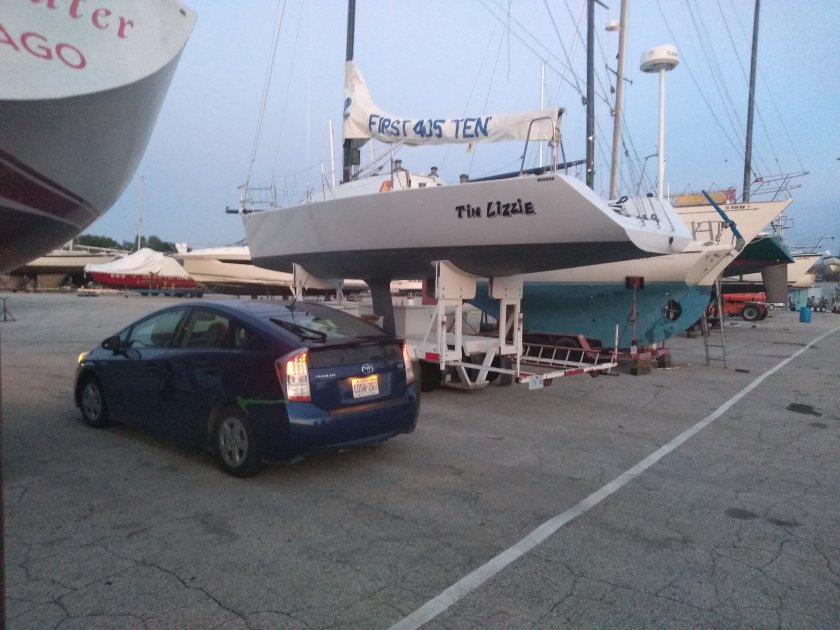
I spent today getting the old graphics off, the rudder in, and some exterior cleaning done. Roamed the ships store making mental lists. The store here is well stocked and can order anything they don’t have. Autopilot should be here in the next couple of days.

I really like the design. There are about 800 sailboats stored ashore here, and I never tire of walking among them. I would stop and admire this boat any time.

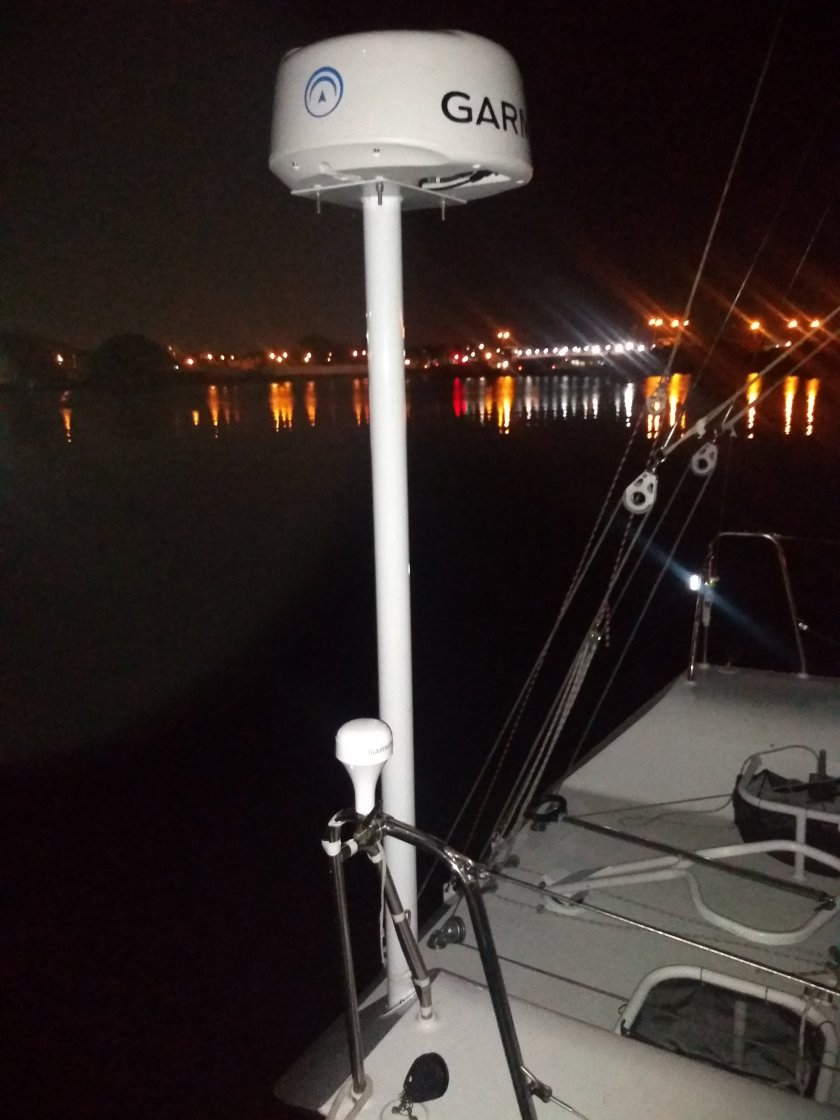
Manfred made the radar mount for me and it’s just what I had in mind and nicely finished.

I’m really excited about this. Can’t wait to start sailing. One step at a time…

Thanks to my partners Sarah and Samantha and the good folks at Crowley’s for supporting me in this crazy endeavor!

The Countdown Begins

I’ve just registered for the GLSS race from Chicago to Mackinac Island June 22. Deadline for registration is Monday and there are 24 boats registered as of now.

This is a big challenge, sailing solo in a 300 mile race. But I’ve laid out the steps required and am going to do my best and see how it goes.

The boat is perfect. I feel fortunate to have found it, and the owner/builder was very cooperative and helpful, and cleaned and packed it up nicely. I have some work to do, but it’s manageable. Should be sailing in a week and in a better position to try to refine sails and sail handling. Got the mast off today and all looks to be well put together and in very good shape.

Chicago!

Well, that was painless. Lizzie is now at the yard in Chicago.

This is a major milestone. I’ve been plotting and scheming about this for three months.

I rented a 3/4 ton truck – a new F250 diesel – from Enterprise Truck Rental in Indiana, drove to Ontario, closed on the boat, and towed it here. Just returned the truck. Nice machine, very stable and gobs of power. Total cost including rental, fuel and tolls was about US$700. Trailer was very stable. I didn’t have the hitch high enough, but no issues. I also talked with Enterprise in London, and they had similar pricing and availability. I wasn’t sure about renting a tow vehicle, but it was easy and effective. I’d do that again.

It’s cold and rainy here tonight, but sunny tomorrow. I’m looking forward to getting to know Lizzie better then. I have lots to do but hope to be sailing within a week.

Here we are leaving St Thomas. That’s where the boat was built.

And at a stop in MI

PHRF update

I had a lovely chat yesterday with the chief handicapper.  He’s been in the role for 20+ years.  Too long, but not a lot of people willing to take it on these days.  We probably talked for a half hour.

The gist of his message was that they have never assigned a rating for a boat that included the use of movable water ballast, and that it would be problematic and potentially controversial within the committee to deal with a request for this.

I especially appreciated his clear interest and understanding of the boat and system, and we talked at length about some of the possible advantages that the system offered, like lightening the boat off the wind.  I also got a sense of some of the issues that sport boats have introduced for the handicappers.  Probably this isn’t the first time he’s seen the issue raised. By the time we finished I was almost resigned to racing without using the water ballast.

As I thought about it during the day, I realized that this just wasn’t going to work for me.  I bought the boat in part because it had this system, and would allow higher performance through a broad range of conditions.  The entire design of the boat was influenced by the allowed use of the system under the original class rules.

I also thought about my motivation.  It’s not to gain some advantage over my competitors.  It’s not to exploit some rule loophole.  It’s not to get a favourable rating.

I’ve got a boat that was designed in the mid 1990s to a box rule that was meant to develop fast safe offshore boats to be raced with small crews.  It’s not a sport boat.  It’s not a freak.   There has to be a solution.

I called a GLSS sailor I had briefly met this spring and reintroduced myself, then launched into my saga.  He took it well, and we were soon having a super interesting and informative discussion.  One of his suggestions was to try for a restricted certificate for single handing.  That struck me as a good suggestion, in part because it would alleviate any concerns from the handicappers about me showing up and winning a major regatta out of the blue.  I’ve got to think that’s a nightmare situation.

So I’ve written back to the handicapper asking for a rating to include the use of the WB and offering this idea.  I also tried to indicate that I wasn’t going to squabble of any adjustments to the base rating.  We’ll see.  I want to be reasonable, and I don’t think what I’m asking for is unreasonable.  Hopefully we’ll get a reasonable outcome.


PHRF and water ballast

I’ve been sort of dreading dealing with getting a PHRF rating for Tin Lizzie.

At issue here is water ballast, which my boat has. The best description of this is an article by the designer of TL. He describes in detail the system used on Mount Gay 30 and other characteristics of the boat. Read here.

When I started thinking about high(er) performance solo sailing one of the first things that came to mind is water ballast. It just makes sense. Before I came across TL I was entertaining fantasies about installing a water ballast system in an old J/35. I though about a narrow boat but had an Aphrodite 101. Been there, done that. I prefer something beamier and more powered up.

Now here’s the weird thing. The system on TL has never been used while racing. And in researching this, I came to realize that the commonly used handicapping rules have consistently penalized these systems out of existence.

That’s a pretty strong claim, I know. But the more I think about it the more convinced I am that I’ve got it right.

The world of handicapping is a complicated and often highly politicized one, particularly PHRF and its derivatives. And I’m generally by temperament and aptitude more sympathetic with the handicappers than the competitors. I want to be clear this is not meant to be a rant against the handicappers. We should all appreciate their efforts.

One more note: I’ve been in a bit of a time machine. Last time I was seriously involved in this game was 30 years ago. So sorry if I’m not current on lots of stuff or use outdated terms.

Anyway, back to water ballast. TL carries 300 l per side, so 300 kg. The positioning is such that it’s roughly equivalent to 3-4 crew sitting on the rail. So under some conditions that will give a noticeable performance gain. It is easy to quantify. Just substitute ‘using water ballast system’ with ‘sailing with three big extra people who jump from side to side’. In fact the live ballast is more effective in short course racing, while WB probably holds an edge for distance racing. But they’re broadly equivalent in terms of performance.

Modern keelboat classes have long recognized that boats with lots of rail meat were faster, and most have maximum specified crew weight that competitive teams try to come close to.

It seems PHRF has done something similar, issuing maximum crew weight limits on a boat’s certificate. I expect that TL would have a max of something like 800 kg.

But here’s the thing. The rules get weird on this. I’m allowed to sail with a crew of eight acting as human ballast, and the handicap assumes that when assigning a rating. If I choose to compete with a crew of 4-5 I would be at a competitive disadvantage, i.e. I would not be able to sail to the assigned rating because I wouldn’t have as much ballast on the rail. There is no adjustment available for that case.

My intended use is shorthanded racing. I never intend to race with more than 400 kg of crew.

It turns out there is a perfect solution, and it’s on my boat. I’ll sail with <400 kg of crew, and utilize my 300 kg of water ballast, always staying under my rating limit.

The Mount Gay (nee Whitbread) 30 class is long gone, but that was exactly the intent – to allow smaller crews to remain competitive against their fully crewed competitors. They specified maximum crew weights with/without WB.

Think about it. How can I compete with a small crew against a fully crewed competitor? There is no case where water ballast will give me a competitive advantage as long as we stay within the limit. Its use will merely close the performance gap between us.

If only it were that simple! I’ve sent notes off to the local PHRF organization announcing my intent to use WB. We’ll see what happens but I fully expect that its use will incur an exorbitant penalty. Will keep up to date here. The more I think about it the more I think I’ll argue strenuously against a penalty.

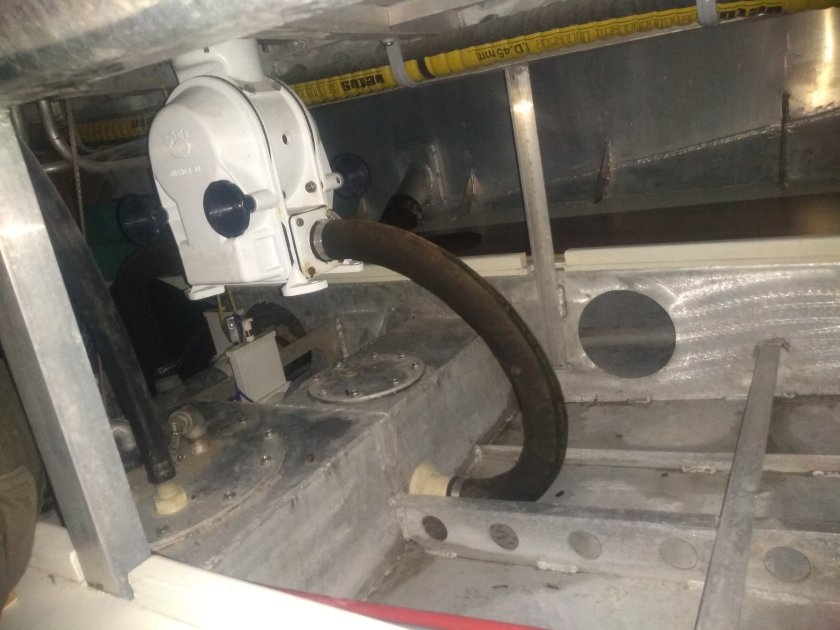
Here are some pics of the system on Tin Lizzie. Water comes in and out here

There is a big Whale pump and the controls for three valves in the cockpit.The clam vents on the deck are for the tanks.

Under the cockpit. There is an intake manifold connected to a tee and valves with 3″ pipe.

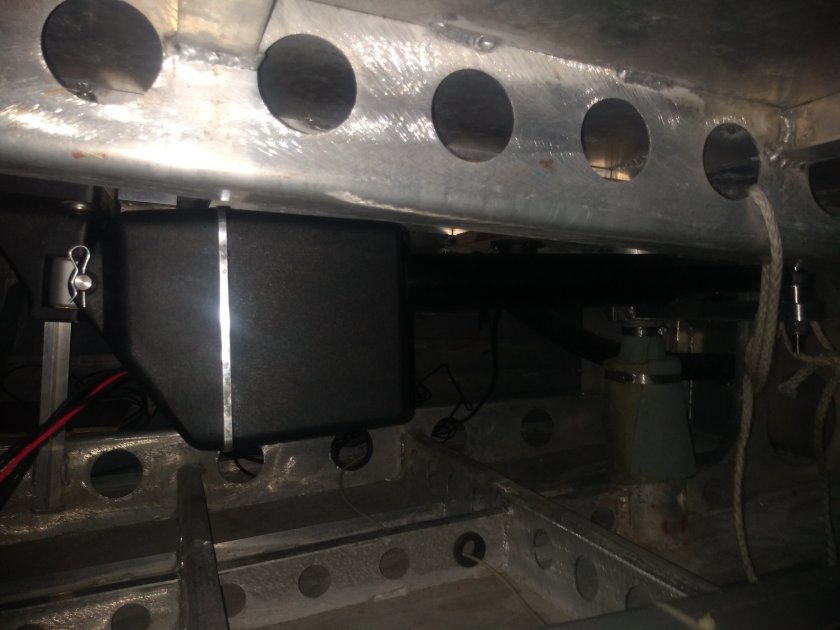
And here are the tanks

Up the Hudson

I left early in the morning and headed around past Perth Amboy and up the west side of Staten Island. Lots of industry.

Then into the Lower Harbor, past the Statue of Liberty and Ellis Island, and up the Hudson. I wasn’t really tempted to venture into the East River. I had a fair current as well so just kept on.

The Tappan Zee Bridge was pretty cool. They built a new one beside the old and were in the process of demolishing/dismantling the original

Then on up the river

It was starting to rain as I stopped for the day near Peekskill. Right next to the nuclear power plant, in a little inlet off the river, here. About 5 feet of water, snug and protected.

In Praise of Shoulder Season Cruising

I’ve been anchored here in Great Kills Harbor for 48 hours. Here’s the view as I write in the cockpit in shorts.

Pretty nice, huh? I love this place. Went to the S side of the harbor yesterday in my dinghy, easy docking and several very good restaurants right there. Today I went over to the boat ramp and biked to a nice grocery store. If I wanted to go to Manhatten there are buses within a block or two. And it’s free! My kind of place.

As an alternative, the cheapest transient dock in NYC would cost about $100/night in season, and there are places where it’d be $300 for my boat.

In the summer of course the harbor would be full of boats and have more people ashore. Might not be a great place. But it’s lovely right now.

That got me thinking about my trip up the ICW, and timing of the trip, and the trade offs that go with doing it at different times of year. Think that’ll be another entry.

Tomorrow I haul anchor and go exploring. I’m going to go over to the Jersey side and around Staten Island, and see where that takes me. Maybe come back here, or to another harbour at 78th St on the Upper West Side.

New York!

This is the only picture I took today. You can see the city on the horizon.

Unfortunately shortly after I took it the rain started, and visibility went down.

I’m anchored here in a big man-made yacht harbour on Staten Island. Nice spot, secure and quiet. I can get ashore in the dinghy, and am ready to.

Nothing remarkable about today’s travels. I got close to a humpback whale just off Sandy Hook. I was in about 25 ft of water and it was sort of lounging around on the surface. Not much traffic in the Lower Bay, but a big catamaran crossed behind me at close to 40 knots. Maybe a fast ferry.

Weather looks nice for the next couple of days. I’m going to spend a couple of days exploring before heading up the Hudson.

Manasquan Inlet

I’m anchored here. Not the greatest spot, but it’ll work. It’s calm now, first time in about a week. The reversing tidal current runs at about 2 knots. And no traffic. Most of the boats here are still shrink wrapped.

I slept in a bit this morning, then headed up to Tom’s River. Went right up to the top and tied up at a nice little park and had lunch ashore.

After Tom’s River I didn’t see anywhere I wanted to explore, and headed up the bay. I liked the clouds in this shot.

Eventually we got to the canal running between the top of Barnegat Bay and the Manasquan River. The tide was favourable and we had a 4-5 mph tail current.

Tomorrow it’s NYC! Lower Bay is about 25 miles away. Out the inlet, turn left and follow the shore.

I was first planning to steam right through, but I’ve been reading and looking at maps, and I think I might stay a few days. I’m a week ahead of schedule. There’s a mooring field at 78th St that looks great. Tomorrow I’m going to Great Kills on Staten Island, which also looks like a good stop.

Forked River

Wow. I’m not sure I’ve seen this many boats in one place. They’re mostly ashore right now. I remember seeing this boat (Paquet) some time in the past. Nice old McCurdy & Rhodes design.

Had a nice trip across the bay. When I went into the mud I was overheating a bit trying to drive through the mud before I stopped to wait for the tide. Cleaned out the strainer basket and all is good. Floated free after about 2 hours.

I just anchored here for the night.

Pics coming across the bay

Wind is forecast to drop tomorrow. Monday is rain. Looks like Tuesday will be the trip around Sandy Hook and into NY. I’m happy to noodle my way north to Manasquan over the next two days. That’s the jumping off spot for the open water run to NY.